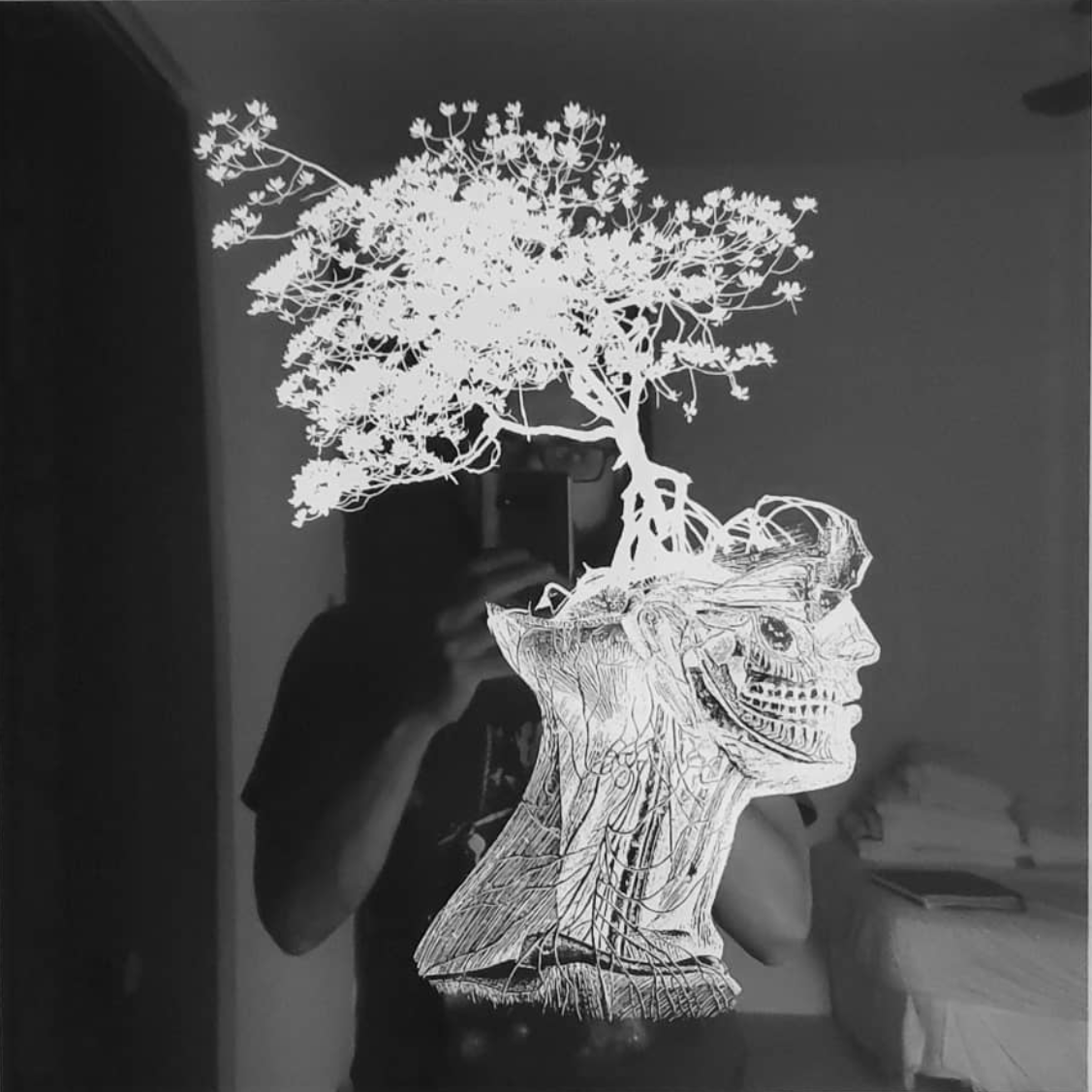
A triptych is a work of art (usually a panel painting) that is divided into three sections, or three carved panels that are hinged together and can be folded shut or displayed open. Beyond its association with art, the term is sometimes used more generally to describe anything with three parts, particularly if integrated into a single unit.
I. Lux Natura (Latin for “Light of Nature”. Inspired by talks from Terence McKenna where I was introduced to the phrase):
- Overall this section discusses life from the atomic and molecular level, particles that were a part of the beginning of our universe and the explosion of stars that not only animate planets and galaxies but the very fibers of our material being. I wanted to convey the essential nature of human beings being on a continuum with the larger whole of the universe. You can read the first section as speaking simultaneously about the universe and also a single human being. Structurally it shows liberal use of alliteration to showcase rhythm and harmony.
- “Movement from stasis, agency faceless, affording as basis / Tiny entities…”
”Before” the Big Bang along with using the Buddhist idea of sunyata (literally, no-thingness – which can also be interpreted as “limitless potential” that drives and animates the universe). “agency faceless, affording as basis” refers to the mystery of how our universe can display intelligence from seemingly non-intelligent matter, which then become the bedrock of all that is.
- “…vagabond molecules beacon their traces, like deacons with gilded censer / That zephyr their graces”.
Using the metaphor of the spreading of particles throughout the universe and even throughout our bodies like the spread of incense during an Eastern Orthodox church service, combining the profane with the sacred.
- “… itinerant particles glimmer in shoal, / Shimmers unfold in a regatta writhing through rivulets, “ parts within a whole gliding as silhouettes”
Now these tiny entities come together to create a larger whole from their individual natures, as if a shoal of fish swimming in unison by instinct, combined with the visual metaphor of a regatta (a race of several ships), traveling along quantum paths and the blood vessels in our veins. “Shimmers unfold” and “parts within a whole” along with “writhing through rivulets” and “gliding as silhouettes” offer an inline rhyming scheme.
- “Fortuitous course of Atom’s nebulous journey…”
Taken from Lucretius, a Roman poet and philosopher, who viewed the soul or mind as emerging from a “fortuitous arrangements of distinct particles”; order derived from a chaotic beginning, offering one of the earliest examples of a kind of naturalism.
- “Joining the choral canon rhapsody on the peering Eave of a chrysalis”
Metaphorically using the energy and flow of nature as a beautiful musical movement – choral as in singing, a canon (a melody played by one instrument or group of instruments, and then repeated a certain number of bars later by another instrument to overlap the initial melody – as in a loop), and a rhapsody (a one-movement piece of music that explores multiple free-flowing sections that don’t necessarily relate to one another.) Canons and rhapsodies are not similar musical movements but this was done purposely to create irony and tension; using canon is a reference to the overall theme of recursion that moves throughout all three parts of Triptych. “Atom” and “Eave” are also a play on “Adam” and “Eve” and the story of creation.
- “Material energy traversing a novel overture incurs apocalypse…”
Apocalypse as in “revelation” or “disclosure”, not the “end of all things” as it is normally understood. I also used that word purposely to ironically juxtapose “overture” and “apocalypse”, as overture being the beginning of a musical piece.
- There is a puzzle within this section with a hidden word that appears twice: metanoia (spiritual conversion/awakening/enlightenment), which is another main theme that runs between the first two sections – and is a term used explicitly in “Quanta / Qualia”
- The first letter of each word on the last line of the section spells out “metanoia”.
- The deeper algorithm is more subtle: take the first letter of first word in the first line, then the first letter of the second word on the second line, then the first letter of the third word on the third line, etc. for each line of the section, and the word that is spelled out is also “metanoia”.
II. Quanta / Qualia (plural of quantum – quanta being a physical unit of measurement and qualia being the first person phenomenological experience we have in consciousness):
- This section discusses both, not as opposites but working together to create physical experience. One seemingly cannot exist without the other.
- “Light” and “nature” are the first 2 words which reflect the first section’s title, playing again on the theme of recursion that plays throughout each section.
- “As above, so below” refers to the idea conveyed in the previous section of the universe and ourselves being a part of a greater whole.
- A reticulum is a network or a netlike formation or structure, which reflects the “rhizomatic field” terminology in the previous line. A rhizome is often taken as being synonymous with “root”; in botany, a rhizome is a plant structure that grows underground and has both roots (commonly, the part that grows down into the ground) and shoots (commonly, the part that grows up through the ground).
The word is associated with postmodern theorists Gilles Deleuze and Felix Guattari, who use the rhizome to describe a process of existence and growth that does not come from a single central point of origin. In A Thousand Plateaus, Deleuze and Guattari name arborescence or the model of the tree as the paradigm for knowledge and practice in the modern Western world; in this model, a small idea—a seed or acorn—takes root and grows into a tree with a sturdy trunk supporting numerous branches, all linked to and traceable back to the original seed. The seed or acorn thus is the beginning point of a coherent organic system that grows vertically and progressively, continually sending out branches that are part of, and identical to, the point of origin. This arborescence, they argue, is the way Western logic and philosophy has worked: in this case, Plato might be the seed and all subsequent philosophies are outgrowths of Platonic thought.
In the postmodern world, however, Deleuze and Guattari argue, the grand narrative of arborescence falls apart. They offer instead the rhizome or fungus, which is an organism of interconnected living fibers that has no central point, no origin, and no particular form or unity or structure. A rhizome does not start from anywhere or end anywhere; it grows from everywhere, and is the same at any point. As such, a rhizome has no center, which makes it difficult to uproot or destroy; you might think of a mold or fungus, which can reproduce from any cell. Postmodern culture resembles this rhizome more than the tree, according to Deleuze and Guattari. An example of this might be the internet, the World Wide Web, which has a rhizomatic structure. It has no point of origin, no central locus, nothing that controls or shapes or organizes it: the web simply grows. You can take out any link or any website (even any web browser) without damaging or changing the internet—it continues to exist without path or pattern. So you can think of this “rhizomatic field” in both senses – as a root, or as a seemingly infinite network with no clear origin.
The idea of a network of quantum to molecular to physical to biological to societal to planetary to galactic realities is a symbol I use as a way to understand the Cosmos (i.e., all of reality as a continuum) that is recursive within itself and of itself – the Dao or the Neoplatonic One as examples of the emanation and emergence of all things.
- “Reaping the pretty prisms of your waking life, / Sundering each vision as if picking apart the seams that bond each node, / And storing these harvested dreams like palms of grain, waiting for a time when your deeper hunger yearns for them again, / Savoring each taste in phases…”
Color can be thought of in physical terms as wavelengths of light. I use the prism as a way of exploring and understanding color with our vision but also symbolizing the colors and tones of our lived experience and all of its emotional reality, being able to articulate each beautiful part of our lives. I then move to the sense of taste, using a different metaphor to understand the same reality from a different lens, in the form of food and nourishment. The line “waiting for a time when your deeper hunger yearns for them again, / Savoring each taste in phases…” has different meanings – one of remembering the beautiful impressions and moments of our lives (coming back to them like the nostalgia of an amazing meal) as well as savoring moments of experience in the present while we can still experience them if we are willing to live in the moment.
- “…like the encoded yolk of Easter eggs hidden within these phrases, decoding the developing aesthetic plot…”
This is an overt clue to the reader to hint that there might be some puzzles hidden within the text (which there are). The terms “encode” and “decode” are purposely used (which will refer to the term cipher in a later section) , the “developing aesthetic plot” referring to the story of every individual person. “Plot” also references the previous line as in a “plot of land” that the “harvested dreams like palms of grain” come from.
- “The narrative not optical illusion but mise en abyme*, an immanent Moebius strip…”*
”Plot” in this line now referring to the “narrative” of every individual. Mise en abyme is a French term used in art that can basically mean a story within a story or an image within a image. It can mean self-reflection or introspection in a literary or other artistic work; the representation of the whole work embedded in a work. It literally means “put into the abyss”, which then reveals an existentialist layer of meaning in reference to the idea, conveyed in the thought of Kierkegaard and Heidegger, of “thrownness” – being put into the world – or the abyss – without any consensus on how to live. A Moebius strip is a one-sided surface that can be constructed by affixing the ends of a rectangular strip after first having given one of the ends a one-half twist. This space exhibits interesting properties, such as having only one side and remaining in one piece when split down the middle. It is one of the hallmarks of the work of M.C. Escher, who uses themes of recursion in his own work. It is also related to the concept of a “strange loop”, which is a situation where, by moving only upwards or downwards through a hierarchical system, one finds oneself back where one started. These loops often involve self-reference and paradox, which is what this line in this section is ultimately trying to convey.
- “Embracing the coincidentia oppositorum, offering theosis via metanoia…”
The concept of coincidentia oppositorum, or “coincidence of opposites,” refers to the harmonious union of contradictory elements, where opposing forces converge without destroying or blending their constituent parts. This idea is rooted in the philosophical and theological works of 15th-century German polymath Nicholas of Cusa. Theosis is a transformative process whose aim is likeness to or union with God, as taught by the Eastern Catholic Churches and the Eastern Orthodox Church (this also references back to the line in Lux Natura – “like deacons with gilded censer / That zephyr their graces”. Metanoia again refers to spiritual conversion/awakening/enlightenment. In other words, becoming godlike or Christ-like or exhibiting your Buddha-nature happens when one is open and enlightened to a path towards wisdom (not necessarily in a traditional religious sense, but in a philosophical and sacred sense, even for those who do not believe).
- “Transcendent font of perpetual disclosure, / Form to symbol, / Sublime / Recursion.”
In Neoplatonic thought, this “Transcendent font of perpetual disclosure” can refer to the One – that which is the ground and totality of all Being, that which everything emanates from and that which discloses its reality to us as we can gain more knowledge and wisdom on the scientific as well as the spiritual paths. “Font” is used here with a double-meaning – font, as in the source of something, and as reference to the next line, “font” referring to “symbol” used in language. The term “recursion” is explicitly used here to refer to the over-arching theme of each section and the totality of Triptych. – There are multiple puzzles/Easter eggs hidden within this entire section:
- The structure of the section follows a Fibonacci sequence, which is an example of recursion in mathematics.
- The total number of words used is 108. Each line follows the following pattern: (1+1+2+3+5+8+13+21+21+13+8+5+3+2+1+1)
- The number 108 holds spiritual significance: In Hinduism and Buddhism, 108 is considered a sacred number, often associated with spiritual completion, meditation, and prayer. For example:
- In Hindu tradition, garlands of prayer beads (mala) typically have 108 beads, used to count mantras during meditation. 108 can also refer to the amount of names of Lord Vishnu and Lord Shiva.
- In certain forms of Buddhism, the number 108 is believed to represent the distance between the human body and the divine.
- In Tibetan culture, 108 is considered a sacred number, symbolizing the wholeness of existence. It is often used in meditation and prayer practices.
- In numerology, 108 is believed to hold spiritual significance, representing completion, harmony, and balance. It is often associated with guidance, introspection, and self-reflection.
- Finally, 108 is a significant number in the TV show Lost, one of my all-time favorite shows, so it also holds a special meaning for me.
- The sequence of the poem can also (more or less) be read from top to bottom and from bottom to top and still make sense. This also conveys the concept of recursion, strange loops, and the Moebius strip mentioned earlier.
III. Golden Mean (which has a double-meaning: it first refers to the “Golden Ratio” used in some artistic works as well as seen in specific aspects of nature – sunflower spirals, artichokes, etc. It is also related mathematically to the Fibonacci sequence, which is used in the previous section; it also refers to the “Golden Mean” in philosophy, an approach to ethics that emphasizes finding the appropriate medium, or middle ground, between extremes. The phrase golden mean is most frequently applied to the ethical ideas of Aristotle. Similar ideas can be found in many cultures, notably in the teachings of Jewish scholar Moses Maimonides, in the “middle way” principle found in Buddhist philosophy, and in the “doctrine of the mean,” or zhongyong, in Confucianism.
- “And the ratios / In proportion to your core /Hemispheres cipher ~”
The structure of this sections follows the haiku poem structure. Overall the meaning of this section works in several ways:
- It plays on the previous section that reflects the Fibonacci sequence in its use of mathematical symbolism (ratios, proportions, etc.)
- “Core hemispheres” refers to Yin and Yang, the coincidentia oppositorum, of reality, and it also refers to “your core hemispheres” which refer to the hemispheres of our brain, conveying the creative tension and, ultimately, the union of conflicting natures that nevertheless describe reality and our physical body. Both brain hemispheres must work together (be “in proportion” with) as an integrated whole, and we also must be in balance with Nature.
- This section also has a hidden puzzle using a similar algorithm seen in the first section, with one caveat: take the first letter of each word and it spells out “A triptych”. The last word of the section is deliberate, “cipher”. So the phrase as a whole is revealed: “A triptych cipher”, or code, which has a double-meaning in this context:
- Cipher as in a cryptographic algorithm for performing encryption or decryption – a series of well-defined steps that can be followed as a procedure;
- Cipher as understood in dance and hip hop culture: the former being a dance circle where performers take turns dancing to music, and the latter as a rap circle where rappers take turns rapping with each other.
And taking in the term “cipher” in the context of thinking of a circle, the tildes (~) used in the first section and used here after the last word reveal that the entire triptych can be read as an infinite loop: “…In proportion to your core /Hemispheres cipher ~ Movement from statis, agency faceless…”
”Cipher ~ Movement” conveying circular movement in life and reality and reflected in the overall triptych structure of the poem as a whole. The cipher/circle here is also an ouroboros, which is often interpreted as a symbol for eternal cyclic renewal or a cycle of life, death and rebirth.
 svpoetry